
Recursos
Stop Broadcasting. Vision AI Delivers the Right Ad to the Right Person — Right Now
- 2026.07.01
Interactive Ads · Gender/Age Analysis · Privacy-Safe · Personalized Advertising
Stop Broadcasting.
Vision AI Delivers the Right Ad to the Right Person — Right Now
In-store advertising has spent decades talking at customers. It never asked who they were and never checked whether anyone listened. That era is over.
BY THE P2ACH AI TEAM
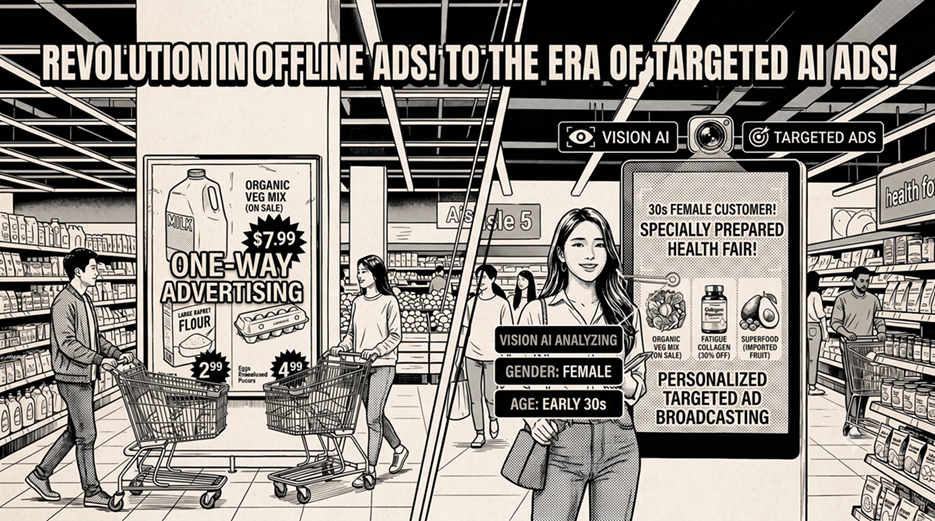
Monday morning. The digital display at the supermarket entrance loops a weekend promotion. Wednesday afternoon — same screen, same content. Saturday evening — still running. Whoever walks in, whatever time it is, whatever they came to buy: the screen broadcasts the same message on repeat. This is what "in-store advertising" has meant for most of retail history.
Meanwhile, the moment that same customer pulls out their phone and opens a shopping app, something entirely different happens. An algorithm instantly assembles what it knows — gender, age range, recent purchases, browsing patterns — and surfaces the products most likely to convert. Same customer, same store, same moment. The precision gap between online and offline advertising is that stark.
① A Digital Screen Does Not Make a Digital Ad
Digital signage and payment kiosks have proliferated across retail environments worldwide. But a digital display is not the same as digital advertising. Most in-store screens still operate as sophisticated slide projectors — pre-loaded content cycling through a predetermined playlist on a timer. The format is new. The logic is decades old.
The problem is structural. The ad doesn't know who it's talking to. Whether the person standing at the shelf is a woman in her twenties, a man in his fifties, or a parent with a toddler — the screen runs through its rotation without any of that information. Advertising without targeting isn't really advertising. It's ambient noise.
Payment kiosks compound the waste. The seconds a customer spends waiting to complete a transaction represent the highest purchase-intent moment in their entire shopping journey. Serving a random ad rotation at that moment — when you already know what's in their basket — is a missed opportunity of the most preventable kind.
② The Moment the Display Reads the Customer, Advertising Comes Alive
Vision AI-powered dynamic ad delivery inverts this logic. A camera analyzes visitors approaching a shelf in real time — estimating gender and age group, then passing that signal to a content decision engine in fractions of a second. The screen transitions to the most relevant ad for that customer before they've fully stopped walking. No identity is recorded. No footage is stored. The entire process operates on a privacy-safe, non-identifying, non-storage basis.
The outputs are concrete. A woman in her thirties approaching the skincare aisle sees a promotion for the relevant product line. A man in his fifties passing the health supplements section sees a functional nutrition ad. A parent entering the baby products zone sees a family-oriented offer. The customer doesn't search for the ad — the ad moves to meet the customer.
This is the Intelligent Store Front in practice. Re-ID technology tracks the same anonymous visitor across zones — without identification — to understand which moments in the journey drive conversion. GDPR and ISO international certifications ensure the entire system operates within rigorous privacy standards. Customers share nothing, nothing is retained, and yet the experience they receive is tailored to them.
③ Personalized Ads Don't Just Improve Sales — They Create a New Revenue Model
The reason online platforms command premium ad rates is simple: they can prove who saw what, when, and whether it worked. Physical retail can now operate by the same logic. When a store runs precision-targeted ads based on real-time visitor data, it stops being just a sales floor and becomes a media platform — one that generates advertising revenue alongside product revenue.
This is the core value proposition of the Retail Media Network (RMN). Global retailers are already generating hundreds of millions in ad revenue through this model. The differentiator, in every case, comes down to one thing: visitor data. Vision AI is the infrastructure that collects that data in physical spaces — lawfully, safely, and in real time.
Performance data accumulates alongside every impression. Which age groups engaged longest with which creative? Which time slots drove the highest attention rates? This is the evidence that makes ad inventory worth more when it goes to market. Provable advertising commands a premium. Vision AI is what makes in-store advertising provable.
The one-way broadcast era of in-store advertising is finished. The infrastructure to read customers, respond to them, and prove the results already exists. P2ACH AI's Vision AI platform is the fastest path to bringing that infrastructure into your store.
Inquire About P2ACH AI Solutions →